
Amazon Q4 inventory planning goes wrong when the numbers you need to decide what to order, and when, sit in different places. By the time someone puts them together, the shipping dates have passed. Then you pay twice. Your best seller runs out before Black Friday, and your slow products sit in storage into January.
Below, we follow one product through the whole decision: when to order, how much, how to pay for it, and what to do if you are already running low. There is a checklist at the end.
Why Q4 Stock Planning Fails
A Q4 stockout usually starts weeks before November, when you plan the reorder. Four things tend to go wrong.
First, the forecast looks at the wrong month. Many reorders are based on the last 30 days of sales. In October, sales are still slow, so the order is sized for October when it has to cover November.
Lead time is also counted too short. Many sheets only count the supplier's production time. Shipping, prep, the trip into Amazon and check-in all come after that, and each can take longer in autumn.
Then the numbers sit in different places. The buyer has a forecast sheet. The warehouse knows a pallet arrived short. Seller Central shows a shipment still being received. Finance sees the invoice weeks later. Each person has part of the picture, and nobody has all of it.
Last, price changes reach people late. When a supplier raises a price in October, the buyer knows, but the costing sheet still shows the old price. We had this problem in our own business. A price change took days to reach every team, and we kept buying at the old cost until it did.
In each case, the right number reaches the right person too late. That is why holiday inventory planning on Amazon should start with the one date you cannot move, the day your stock has to be at Amazon.
Work Backward from FBA Inbound Deadlines
Amazon gives you that date. For 2026, Amazon's holiday announcement to sellers asked for Black Friday Week and Cyber Monday stock to arrive by:
- 14 October for Amazon Warehousing and Distribution (AWD)
- 21 October for FBA shipments with minimal shipment splits
- 28 October for FBA shipments with Amazon-optimized shipment splits
The same post said holiday peak fulfillment fees apply from 15 October 2026 to 14 January 2027. It also warned that capacity limits, which control how much stock you can send to Amazon, may be lower in this period.
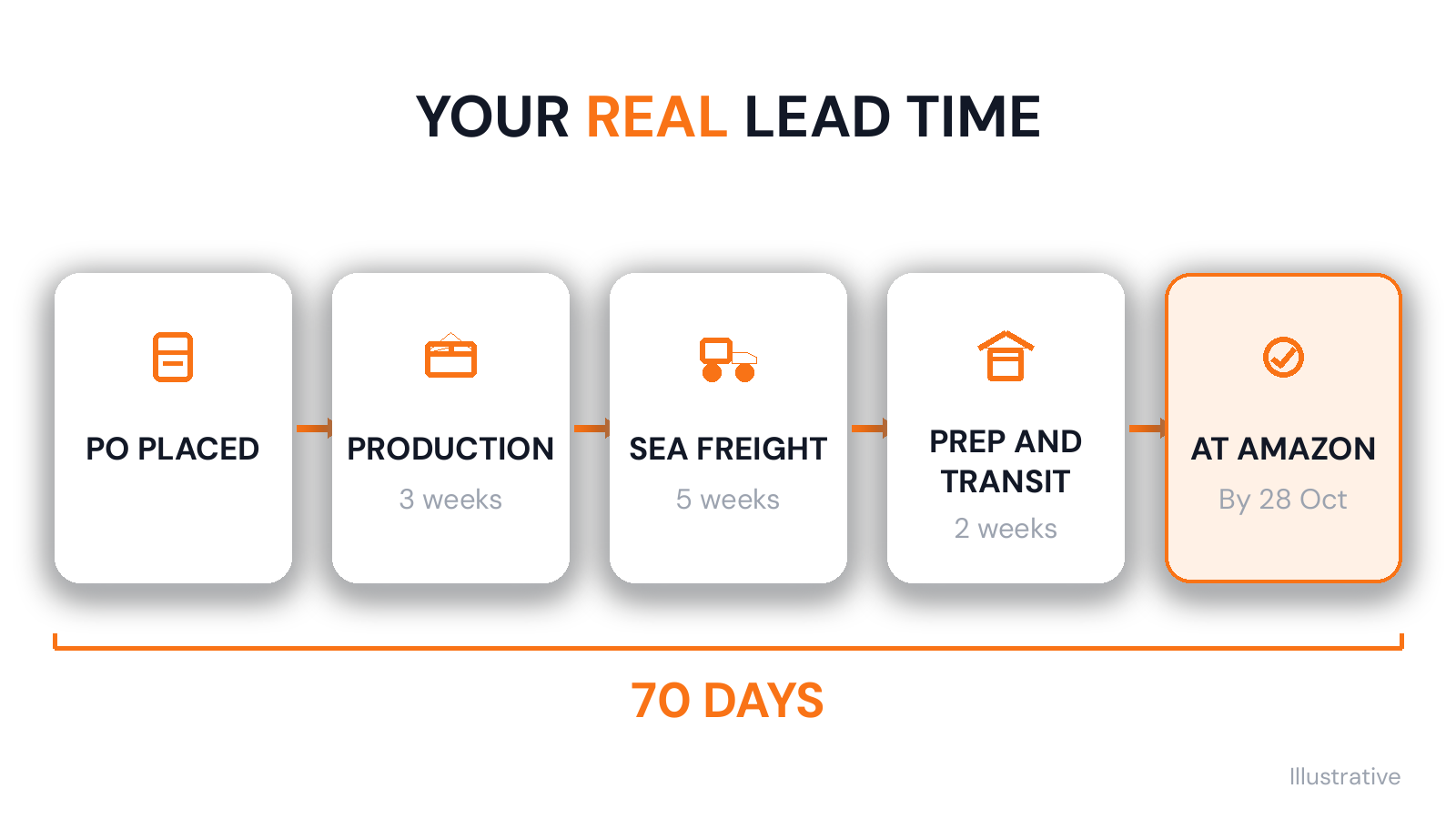
Take one product as an example, with made-up numbers to keep the maths simple. It sells about 20 units a day in October and comes from a supplier overseas. Counting back from the day it reaches Amazon:
- the trip from your prep centre to Amazon takes about a week
- prep and labelling take another week
- sea freight and customs take about five weeks
- the supplier needs three weeks to make and pack the order
That adds up to 70 days from placing the order to the stock reaching Amazon. This is your real lead time. It is always longer than the supplier's quote, because the quote only covers the last step on that list.
Count 70 days back from 28 October, and the purchase order (PO) for this product had to go out around 19 August. With minimal splits, where you ship to fewer Amazon warehouses, the date is 21 October, so the order had to go out a week earlier, around 12 August. Pick your option before you book freight.
This is also why the forecast and the PO should not sit in separate files. If the reorder list is ready on the 15th but someone types up the PO a week later, the order is already a week late.
Set Days of Cover by Product Tier
Now you know when to order. To decide how much, you need days of cover: how many days your stock will last. Divide the units you have at Amazon and on the way there by the units you sell each day.
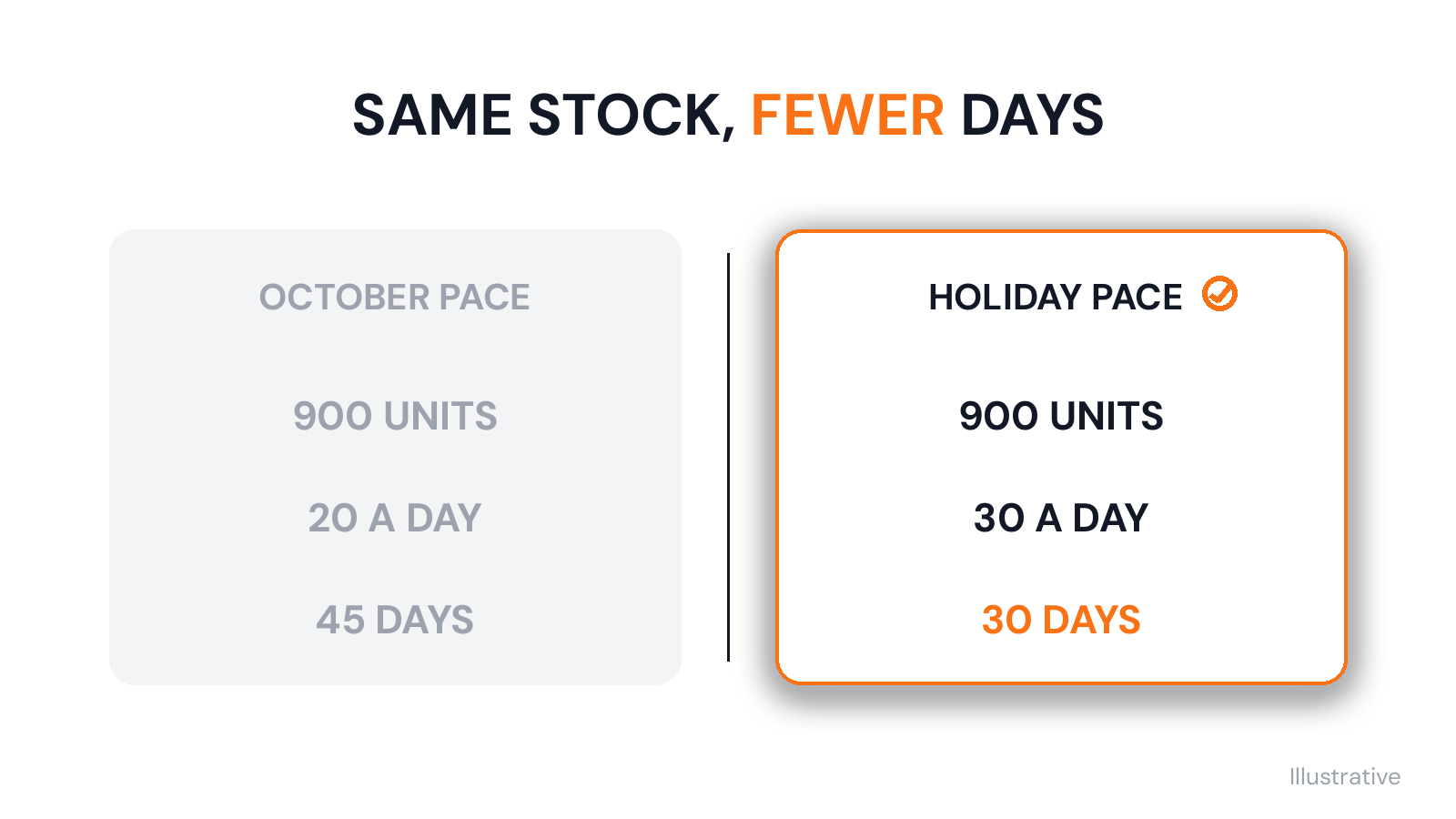
The trap is the daily sales number. Say our product will have 900 units at Amazon on 1 November. At October's pace of 20 a day, that looks like 45 days of stock, well past Black Friday. But if last year's sales point to about 30 a day in November and December, the same 900 units last only 30 days. They run out at the start of December, in the middle of the holiday rush. To find your holiday pace, compare each product's daily sales last November and December with last October.
The new shipment lands at the end of October. Together with the 900 units, it has to last until the next shipment can arrive, which with a 70-day lead time is early January. Add two weeks as a safety buffer, and you need about 84 days of stock. At 30 a day, that is about 2,500 units. Take away the 900 you already have, and the order is about 1,600 units.
Doing this for every product would tie up too much cash, so set targets by tier:
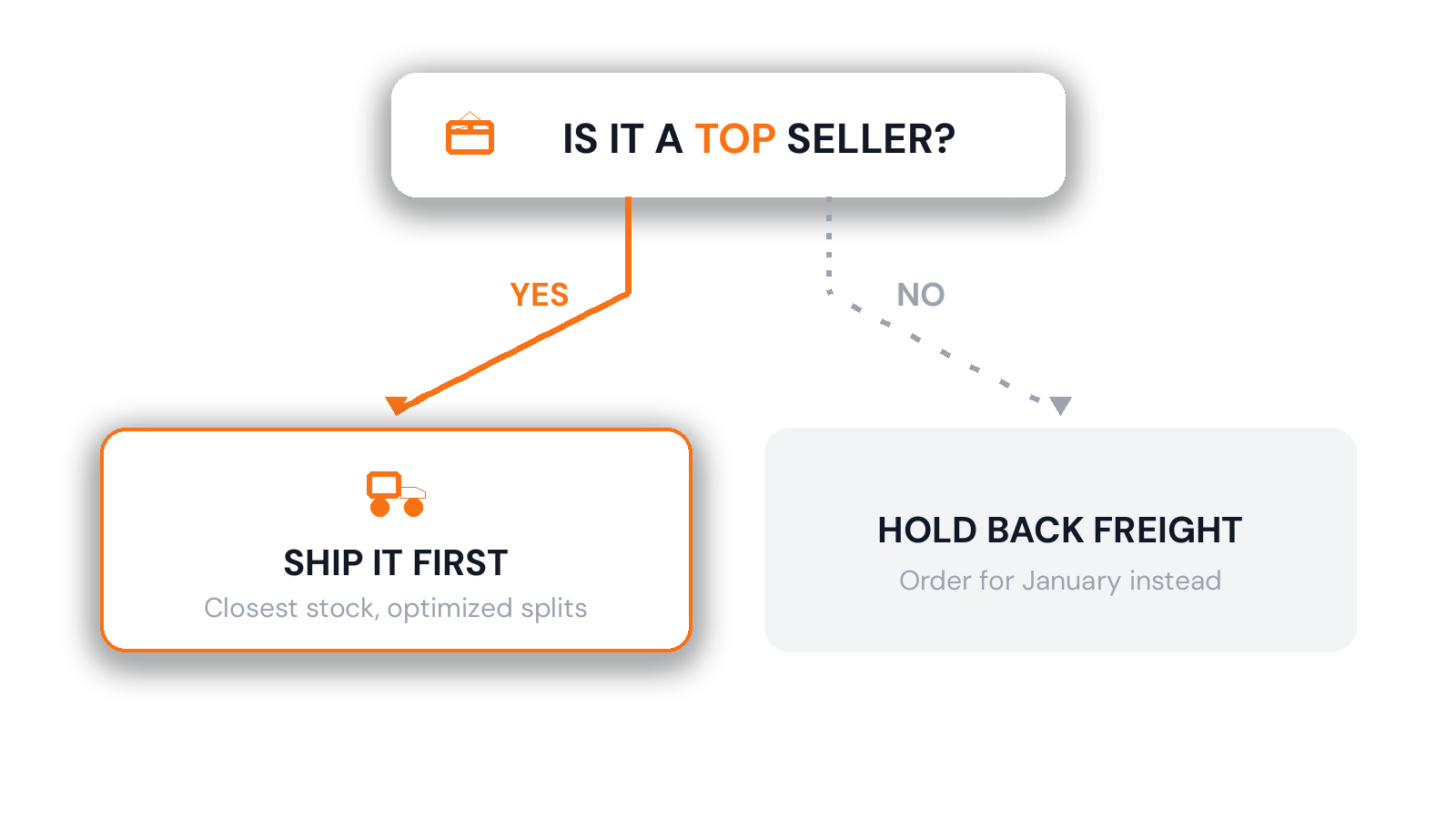
- Tier A: your top sellers with good margins. Cover them through the holidays and into January. They get first call on cash and on space at Amazon.
- Tier B: steady sellers. Cover the peak weeks, then reorder on your normal schedule.
- Tier C: slow sellers or thin margins. Do not build extra stock for Q4. Let them sell down.
Across hundreds of products, this is where spreadsheets break. One out-of-date number copied down a column, and the whole reorder list is wrong. Our own business forecasts across 6,469 SKUs, and no one could keep that right by hand. In Sellerverse, each product has its own stock-day and forecast rules, and the reorder list becomes a purchase order in one click. You can see the forecast and PO flow in the demo.
Cash and PO Timing
Even with tiers, how much you can order depends on cash.
In our example, you pay the supplier in August, often a deposit first and the rest before the goods ship. But the 1,600 units sell from November into January, and Amazon pays you as they sell. For many sellers, Q4 is the biggest order of the year, so this gap is at its widest.
To see the gap, plan week by week from August to January, with every PO payment on one side and every expected Amazon payout on the other. If the balance falls below what the business needs to run, cut Tier C first, then some of Tier B, and Tier A last.
Two costs also change your margin in Q4. The first is the holiday peak fulfillment fee. Every unit that ships between the dates above costs more to fulfil, so add the fee to your landed cost (the full cost of each unit once it reaches Amazon). The second is supplier pricing. When a price changes, update it in the costing sheet, on the open PO and in your margin check before the reorder goes out.
Miss either one, and a product with a small profit in September can lose money in December, once discounts and ads are added too. Our guide to net profit per SKU How to Calculate Amazon Net Profit Per SKU (2026) shows how to find those products, and our reorder point formula Amazon Reorder Point Formula: When to Restock FBA covers when to reorder each tier.
What to Do If You Are Already Low
All of this assumes you started planning in summer. If you are reading this in late October, the 21 October date has passed and the 28 October date is only days away. A late FBA Q4 restock still has options, and the goal now is to make your stock last longer.
Start with your tiers. Give whatever space and cash you have left to Tier A. Stock already at your own warehouse or 3PL can reach Amazon fastest, so send it with Amazon-optimized splits while that date is still open.
Next, slow down sales on products that will run out. Paying for ads or deals that empty a listing before the busiest week makes no sense. Cut ad spend on those items, skip the deal and hold your price. If a product is short at Amazon but you have stock in your own warehouse, ship some orders yourself so the listing keeps selling. It costs more per order, but you keep the sale.
Do not pay for fast freight on Tier C products, which will likely sit in storage into January.
Last, place January's order now. With a 70-day lead time, an order placed this week arrives in early January, when stock that sold out over the holidays needs refilling. Our Q1 restock plan Amazon Q1 Restock Plan: Avoid Stockouts After the Holidays shows how to use your Q4 sales to size that order.
The Amazon Q4 Inventory Planning Checklist
Here is the whole process in order. Use it for your Amazon peak season prep now, and start it in summer next year. Q4 inventory planning checklist download
Every line here depends on a number someone else in the business holds, and in Q4 those numbers change every day.
Plan Q4 from One Set of Numbers
Each step in this checklist depends on the one before it. You cannot set the order size until you know the lead time, and you cannot plan cash until you know the order size. When those numbers sit in different places, someone spends Q4 copying them from one file to another, and decisions wait. Amazon Q4 inventory planning gets much easier when every team works from the same record.
That is why we built Sellerverse, after years of running our own business in pieces. See how Sellerverse runs the whole business from one connected platform. Setting it up takes some work, and the numbers are only as good as the costs you enter. When you are ready, start your 14-day free trial.